I study computational models that connect molecular and cellular perturbations with phenotypic outcomes. My current interests include perturbation biology, AI virtual cells, single-cell transcriptomics, AI-driven drug discovery, and phenotype-based drug design.

Perturbation Biology AI Virtual Cell Single-cell Transcriptomics AI-driven Drug Discovery Phenotype-based Drug Design

Education

PhD in Biology

Tsinghua University, 2025-present

Advisor: Prof. Zemin Zhang

B.S. in Biomedical Science

Shanghai Jiao Tong University, Zhiyuan Honors Program, 2021-2025

Research Directions

  • Perturbation-response modeling from single-cell data
  • AI virtual cell pretraining, deployment, and post-training
  • Phenotype-guided molecular and therapeutic design
  • Computational chemistry for mechanism-aware drug discovery
Skills

Computational Chemistry

Molecular dynamics, docking, homology modeling, pathway analysis, Markov state modeling, and allosteric mechanism analysis.

AI Virtual Cell

Single-cell foundation model pretraining, deployment, post-training, perturbation response modeling, and phenotype prediction.

Deep Learning

Transformer-based, flow matching-based, diffusion-based, and agent-based models, with biology-prior embeddings for biomedical representation learning.

Research Focus

Perturbation Biology and AI Virtual Cells

Modeling how genetic, molecular, and environmental perturbations reshape cell states, with emphasis on deployable single-cell foundation models and post-training for perturbation response prediction.

Single-cell Transcriptomics

Using single-cell data to characterize tumor microenvironment structure, cellular state transitions, and phenotype-level readouts for computational biology workflows.

AI-driven and Phenotype-based Drug Design

Connecting molecular generation, target-aware evaluation, and cellular phenotypes so that drug design is guided by both mechanism and response.

Computational Chemistry and Allostery

Studying conformational dynamics, docking, Markov state models, and allosteric communication in CRISPR-Cas systems and drug-discovery settings.

Featured Publications & Manuscripts
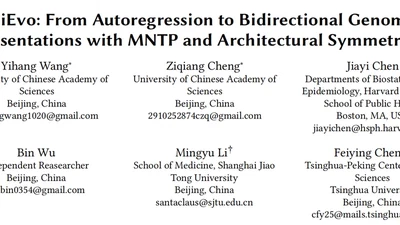
BiEvo: From autoregression to bidirectional genomic representations with MNTP and architectural symmetrization featured image

BiEvo: From autoregression to bidirectional genomic representations with MNTP and architectural symmetrization

Ongoing work on bidirectional genomic representation learning. The project is being actively advanced after the KDD submission cycle and is presented here as a manuscript in …

avatar
Feiying Chen
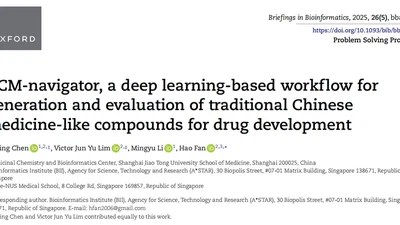
TCM-Navigator: A deep learning workflow for TCM-like compound generation and evaluation featured image

TCM-Navigator: A deep learning workflow for TCM-like compound generation and evaluation

Built an end-to-end AI workflow that generated 3.7 million TCM-like molecules, supports target-specific generation, and links molecular generation to TCM-like quality control and …

avatar
Feiying Chen
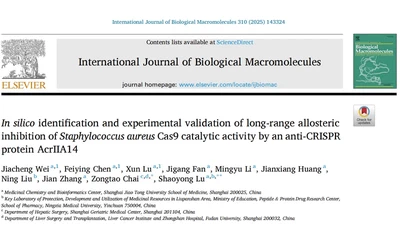
In silico Identification and Experimental Validation of Long-range Allosteric Inhibition of Staphylococcus aureus Cas9 by Anti-CRISPR Protein AcrIIA14 featured image

In silico Identification and Experimental Validation of Long-range Allosteric Inhibition of Staphylococcus aureus Cas9 by Anti-CRISPR Protein AcrIIA14

Combined computation and experiments to map remote allosteric inhibition of SauCas9 by AcrIIA14, highlighting dynamic inhibitory states and potential routes for allosteric Cas9 …

avatar
Feiying Chen
Publications
Research Experience
CancerPKU logo

CancerPKU

PhD-stage research on tumor microenvironment, perturbation biology, and single-cell modeling.

A*STAR Bioinformatics Institute logo

A*STAR Bioinformatics Institute / NUS

Developed TCM-Navigator, an AI-assisted workflow for TCM-like molecular generation, quality control, and target-aware evaluation.

Molecular Design Laboratory logo

Molecular Design Laboratory, SJTU School of Medicine

Studied CRISPR-Cas9 allostery, conformational dynamics, and allosteric database resources for mechanism-aware drug discovery.